
A hurricane watch for the Gulf Coast usually means one thing for a homeowner in Englewood, Venice, or Port Charlotte — the garage door just became the weakest point in the house. Not the roof, not the windows, the door itself. It is the largest moving opening in the exterior wall, and once it fails, wind pressure gets inside the structure and starts working on the roof from underneath. This checklist walks through exactly what to do in the three days before landfall, in the order that actually matters, and it says plainly where the window for action closes.
The 72-Hour Window and What’s Still Realistic to Do
Three days before landfall is when most Florida households are still calm enough to do this correctly. The kids are still in school, the roads are still clear, and the hardware stores still have stock on the shelves. That calm is worth using, because forty-eight hours later none of those three things will be true. If you own the house, rent it, or manage it remotely for aging parents, this is the window where a $40 fastener check can prevent a $4,000 door replacement, and where thirty focused minutes in the garage buys you real protection instead of a false sense of it.
The mistake most families make is treating hurricane prep as one big task that happens the night before. It isn’t one task. It’s several small, mechanical checks that each take a few minutes, and they only work if they happen in the right order — structural first, then contents, then the vehicle, then the final lockdown. Doing them out of order, or doing the fastener check after the door is already braced, wastes the bracing.
Why Garage Doors Fail Before Anything Else
A standard non-impact garage door is rated for far less wind pressure than the walls around it. Builders in Sarasota and Charlotte counties have tightened code requirements over the past two decades, but a huge share of the housing stock in Englewood, Rotonda West, and North Port still has original doors from the 1990s or early 2000s, installed before the current wind-load standards existed. Those doors were never engineered to resist a Category 2 gust, let alone anything higher, and the family living behind one usually has no idea until the moment it starts flexing inward.
Once a garage door fails, the pressure differential inside the garage pushes up against the roof structure from the inside, which is a completely different load path than what the roof was designed to resist from above. This is why insurance adjusters and building scientists keep repeating the same point every hurricane season, and it is worth repeating here too, that garage door failure is one of the single most common triggers of catastrophic roof loss in wind events, and it has nothing to do with the roof itself being weak.
What 72 Hours Out Looks Like in Practice
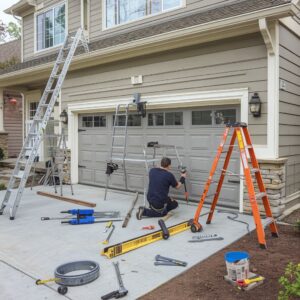
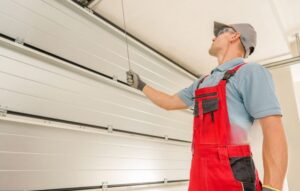
At this stage you are gathering information and materials, not finishing the job. Walk out to the garage, open the door manually if the power is still on, and look at the track mounting points where the vertical tracks bolt into the wall studs or masonry. Count how many mounting points there are. Most standard doors only have two or three per side, which is not enough to resist sustained hurricane-force wind on its own.
If you don’t already own a reinforcement kit, this is the day to buy one, not the day before landfall when the shelves are empty and every hardware store in the county has a line out the door. A horizontal strut kit for a double-wide door runs somewhere in the neighborhood of $150 to $200, and it needs pre-drilled holes matched to your door’s panel width, so measure before you drive anywhere.
Checking Fasteners and Storm Bracing Correctly
This is the part of the checklist that actually determines whether the door survives, and it’s also the part most homeowners skip because it looks like maintenance rather than storm prep. It is both. A loose fastener that’s been rattling for two years is exactly the kind of small failure that turns into a total door loss the moment wind loads spike.
The Fastener Walk-Through
Go around every hinge, every roller bracket, and every point where the vertical track meets the wall, and check each bolt and screw by hand. You’re not looking for anything sophisticated, just movement — a bolt that spins freely, a bracket that wiggles when you push on it, a screw that’s backed halfway out of dried-out wood. Tighten what you can with a socket wrench or screwdriver. If a mounting point is stripped or the wood behind it is soft or rotted, that’s a call to a technician, not a job for more screws jammed into the same hole.
Pay particular attention to the top bracket and the bottom corner brackets, since these carry the most load when wind pushes against the full surface of the door. A door with even one compromised bracket at these load points behaves like a door with none, because the panel will simply pivot around the weak point and pull the rest of the hardware apart with it.
Installing or Deploying Bracing
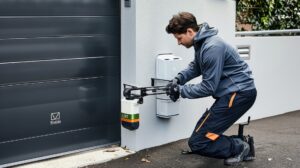
If you have a permanent reinforcement kit already mounted, this is the moment to deploy the horizontal struts and secure them into the vertical brackets according to the manufacturer’s instructions. If you’re installing struts for the first time under time pressure, follow the drilling template exactly, use the hardware included in the kit rather than substitutes from a junk drawer, and torque bolts to snug rather than stripping them by overtightening.
Families with elderly relatives in the home should not attempt drilling into masonry or working on a ladder in the 48 hours before a storm. This is exactly the kind of task worth paying a technician to finish quickly rather than risking a fall or a rushed, incomplete install. A brace installed halfway is not a brace, it’s a false sense of security bolted to a door.
The Parking Mistake That Makes Damage Worse
Every hurricane season, someone pulls their car nose-first against the inside of the garage door thinking the bumper will hold it shut. It won’t, and the reasoning behind it is backwards.
Why Parking Against the Door Backfires
A car parked flush against the door does two things, both bad. First, it gives the door a rigid surface to slam into once wind pressure starts flexing the panels, which concentrates the impact instead of distributing it, and that concentrated impact is what tears panels off their tracks. Second, once the door does fail, the car is now sitting directly in the debris path, catching glass, splintered panel material, and whatever wind-borne debris makes it through the opening. You’ve turned your vehicle into a second casualty instead of protecting it.
The better approach, if the vehicle has to stay in the garage at all, is to park it a few feet back from the door with enough clearance that a failing panel doesn’t land directly on the hood or windshield. If evacuation isn’t required and there’s room, moving the vehicle to the most structurally protected side of the garage, away from the door swing path, is safer than treating the bumper as a brace.
Clearing the Garage Floor and Approach
Loose items near the door — bikes, trash cans, patio furniture that got moved inside at the last minute — become projectiles the second the door fails, and they also become obstacles if you need to get the car out fast during an evacuation order. Clear a path down the center of the garage before you finish bracing the door, not after.
What’s Still Fixable and What’s Already Too Late
Honesty matters more here than optimism. A homeowner who spends the last six hours before landfall trying to fix a garage door that needed a technician three days ago is not protecting the house, they’re delaying the decision that actually protects it.
The 24-Hour Cutoff
Inside 24 hours of expected landfall, new hardware installation, drilling into masonry, and any repair that requires a technician on a ladder should be considered closed. Roads get dangerous, retailers close early or sell out, and contractors are already committed to earlier bookings or their own family prep. If bracing isn’t installed by this point, the realistic options are limited to what you can do with materials already in the garage.
This is also the point where you stop opening and closing the door for any reason other than getting the last vehicle inside. Every cycle of the opener puts the door through motion at exactly the moment high winds may already be starting to gust, and a door caught halfway open in rising wind is far more vulnerable than one that’s fully closed and still.
If the Door Is Already Broken or Off-Track
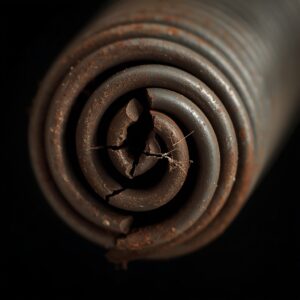
A door that’s already dented, jammed, or partly derailed before the storm even arrives is a different problem than an intact door that just needs bracing, and it needs to be treated that way. Do not force a jammed door up or down manually — a door under spring tension that’s also structurally compromised can come off its tracks entirely and become a hazard to whoever is standing near it.
If a technician visit isn’t possible before landfall, the interim option is covering the opening from the inside with plywood braced against the frame, screwed into wall studs rather than just the door itself, since the door’s own structure may not be trustworthy anymore. This is a stopgap, not a fix, and it should be followed by a full inspection and repair the moment conditions allow safe travel again.
For anyone reading this while a storm is still a few days out and noticing their door already sags, sticks, or grinds when it opens, that’s the signal to call now rather than wait for the emergency to force the decision. Deluxe Garage Doors handles exactly this kind of pre-storm repair and reinforcement work across Sarasota and Charlotte counties, and getting ahead of an existing problem is always faster and cheaper than an emergency call once wind speeds are already climbing.
| Expert insight
We see the same picture every single season. The house is prepared beautifully, storm panels are up on the windows, supplies are stocked, the generator has been tested, and the garage door is still hanging on two original brackets from the nineteen-nineties that nobody has ever checked. A garage door is not a decorative part of the facade, it is part of the building’s structural envelope the moment a hurricane arrives. Checking the fasteners takes fifteen minutes and costs the homeowner nothing once they’re already standing in the garage. Repairing a roof after wind has gotten inside through a failed door costs an entirely different amount of money and an entirely different amount of time. |
Special Guidance for Different Households
A checklist that treats every household the same misses the point. A retired couple who just moved from Ohio has different blind spots than a family that’s lived on Manasota Key for twenty years, and a snowbird checking security cameras from Michigan needs a completely different plan than either of them.
New Florida Residents
If you moved to Florida in the last year or two, you likely inherited a garage door that came with the house, and you have no history with it. You don’t know if it’s ever been serviced, whether it’s the original builder-grade door from construction, or whether a previous owner already reinforced it. The safest assumption for a first hurricane season in a new house is to treat the door as unreinforced until proven otherwise, and to get a professional inspection before the season is already underway rather than during the first storm watch.
Families With Children or Elderly Relatives
Drilling, ladder work, and heavy lifting in the 48 hours before a storm are not tasks for anyone with mobility limitations or for a parent trying to also manage kids who are home from school early. Assign the physical bracing work to someone capable of doing it safely, or book a technician while there’s still availability. The fastener check itself, walking around with a wrench and checking for looseness, is something most teenagers can safely help with under supervision, and it’s a reasonable way to get a household moving on prep together.
Snowbirds Monitoring the Property Remotely
If you’re not physically in Florida when a storm approaches, you need two things arranged well before hurricane season starts, not scrambled together during a watch. First, a local contact with a key or code who can physically get into the garage. Second, a standing relationship with a service company that can do a pre-season inspection and, if needed, a pre-storm bracing visit on your behalf, with photos sent back so you know it actually happened. A smart garage camera helps you watch the door, but it does nothing to reinforce it, and by the time you see a problem on your phone from a thousand miles away, the window to fix it has usually already closed.
FAQ
Question. Can a hurricane brace kit be installed on any garage door?
Answer. Most steel and aluminum sectional doors can accept a bolt-on strut kit, but the kit has to match the door’s panel width and the wall behind the tracks needs solid wood studs or masonry for the anchors to bite into. Wood doors and doors with existing structural damage often need a technician to confirm the mounting points can actually hold before any bracing goes on.
Question. Does a hurricane-rated garage door still need bracing during a storm?
Answer. No, that’s the point of the rating. A properly installed impact and wind-rated door has already been engineered and tested to resist the wind pressures for its listed zone, so bolt-on struts aren’t necessary. What it still needs is the same fastener check as any other door, since a rated door with a loose bracket loses its rating in practice even if the certification sticker is still on the panel.
Question. Is it safe to leave the garage door opener plugged in during the storm?
Answer. Yes, leaving it plugged in is fine and often useful, since it lets you close the door quickly if you opened it briefly to move a vehicle. The bigger risk is repeatedly cycling the door open and closed as wind picks up, since motion during high wind puts more stress on the track than sitting closed and still.
Question. What if the garage door won’t close all the way because of storm bracing already installed?
Answer. A correctly installed strut kit should not prevent the door from closing or sealing at the bottom, since the struts mount horizontally across the inside face of the panels rather than blocking the track. If the door won’t seat properly after bracing goes on, the kit is either the wrong size for the door or installed at the wrong height, and it needs to be adjusted before the storm arrives, not left as is.
Question. Should renters do anything differently before a storm?
Answer. Renters should still check fasteners and clear the garage, since a failed door affects everyone inside the unit, but any drilling, permanent bracing, or structural repair needs the property owner’s involvement, both for the repair itself and often for insurance reasons. A quick call or text to the landlord as soon as a storm watch is issued gives enough lead time to arrange a technician before the 24-hour cutoff.