
There was a bang like a gunshot somewhere in the house, and now the door will not open. Or it opened six inches, groaned, and stopped. Or it went up fine last night and this morning the opener strains and gets nowhere.
That is a spring, almost every time. The short version is that the door is now several hundred pounds of unsupported weight, the opener cannot lift it and should not be asked to, and the safest thing you can do in the next ten minutes is nothing at all. Below is what actually matters, in the order it matters, including the part everybody skips about how to get a car out without hurting yourself.
- Stop using the opener the moment you suspect a spring. Every attempt strips gears, frays cables and can pull the door out of square.
- Do not lift the door by hand as a matter of routine. With the spring gone you are carrying the entire weight, which on a double door runs from about 150 pounds to well over 400.
- The red release cord is not a fix and is not safe to pull while the door is partly open. Released, the door has nothing holding it up.
- • If a car has to come out, it is a two-person job with the door propped, done once, and then the door stays down until a technician arrives.
- Springs are replaced in pairs because they wear by cycles rather than by years. Fitting one new spring beside a worn one buys you a second call, usually within months.
- Most spring jobs are same-day and take under two hours on site. What varies is the hour you call, not the difficulty of the work.
What just happened, in the first minute
Nothing about this is unusual and nothing about it is your fault. Springs are wear parts with a defined service life, and they nearly always fail at the moment the door is asked to move, which is why the bang so often comes just as somebody leaves for work.
The symptoms that point to a spring
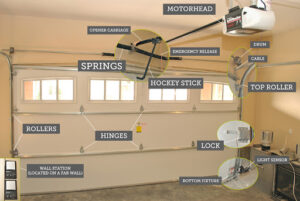
The loud bang is the classic one, and people often describe it as something falling in the attic. Go and look above the door. A torsion spring sits on a shaft across the header, and when it breaks you will usually see a clean gap of two or three inches in the coil. If your door uses extension springs, they run along the horizontal tracks on each side, and a failure there looks like one side hanging loose or the door sitting crooked.
The other signals are behavioural. The opener hums, strains and gives up. The door lifts a hand’s width and stops. The door goes up but comes down hard and fast when you let it. Any of those means the counterbalance is gone.
What it might be instead
A snapped lift cable looks similar from a distance but the door usually sits noticeably crooked, with one bottom corner lower than the other, and the cable is visible hanging slack near the drum.
A stripped opener gear sounds different. The motor runs normally, the chain or belt does not move, and the door does not budge. In that case the springs are fine and the door will lift by hand almost weightlessly once you release it.
There is also the embarrassing one. Somebody threw the manual slide lock on the track, or the door is frozen to the slab in a cold climate. Check the locks before you call.
Stop pressing the button
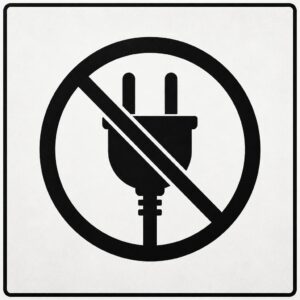
This is the part that costs people money. Every time the opener is asked to lift a dead-weight door, the gear takes a load it was never designed for. Openers guide a door the springs have already made nearly weightless; they do not lift one. A few extra attempts can turn a spring job into a spring job plus a new opener, so unplug the unit if anyone else in the house might try the remote before help arrives.
Do not lift the door by hand
We put this in its own section because it is the single instruction most likely to keep somebody out of an emergency room, and because most advice on this subject moves past it in half a sentence.
What you would actually be lifting
An uninsulated single-car steel door runs roughly 130 to 200 pounds. A double runs from about 150 pounds up past 400 once you add insulation, glass or a wooden facing. That weight is not held by anything now — the opener is not holding it, the tracks only guide it, and the rollers give almost no friction. Injuries around garage doors run into the tens of thousands a year across the country, and a large share happen in exactly this moment, when somebody decides the door cannot really be that heavy.
The red cord is not a solution and has its own hazard
The release cord disconnects the door from the opener carriage so the door moves freely by hand. It does not lower a door, hold a door, or make a door lighter. Pull it while the door is partly open and nothing is restraining the door. It can come down fast, onto whatever is under it, which in a stuck-halfway situation is often the roof of a car. Only pull the release with the door fully closed and everyone clear of the opening.
If you cannot lift it, and plenty of people cannot
This is worth saying plainly, because most articles quietly assume two able-bodied adults are standing in the garage. If you are on your own, if you have a bad back, a recent surgery, a shoulder that gives out, or you are simply not confident about taking several hundred pounds on your legs, the answer is not to try carefully. The answer is not to try.
There is no version of this where the car is worth the injury. Call for service, tell dispatch the vehicle is trapped so it can be prioritised, and in the meantime take a ride, move the second car, or reschedule. A technician who arrives in three hours will have that door open in a couple of minutes, safely, and can retrieve the car for you.
Getting a car out, if it truly cannot wait
Sometimes it genuinely cannot wait. A shift you cannot miss, a medical appointment, a child to collect. If you are going to do this, do it once, do it properly, and then leave the door alone.
Before anything moves
You need a second adult. Not a teenager, not one person and a plan. Clear the opening — children, pets and anything you would not want a door landing on go elsewhere. Make sure the door is fully closed, then pull the release cord so the carriage disconnects. If the door is stuck partway open, stop here and wait for a technician, because releasing it in that position is how doors fall.
Have something ready to hold the door up before you lift rather than after. A pair of stepladders, a length of four-by-four, a solid post on each side. The support goes under the door near the ends, and it goes in before anybody walks under the opening.
The lift
One person each side, hands under the bottom section near the ends rather than in the middle. Lift with your legs, keep your back straight, go slowly and evenly, because a door lifted crooked jams in the tracks and adds a bent-roller repair to your day.
Take it up to where the rollers reach the horizontal track and stop. Put the supports in immediately, because with the spring gone the door will not stay up on its own. Then get the car out. Nobody stands under the door longer than they have to, and nobody reaches back in for a forgotten bag.
Getting it down and leaving it there
Lowering is the more dangerous half, because gravity is now on the door’s side. Both people again, one at each end, hands on the bottom section, letting it down in stages rather than one long slide. Then stop. That was your one time. Every repetition raises the odds of a jam, a pinched hand or a door coming down faster than expected, and there is nothing left in the garage worth that.
Keeping the garage secure while you wait
A few hours with a door that cannot be operated is a small security problem as well as an inconvenience, and it takes two minutes to deal with.
A released door is not a locked door
Once the carriage is disconnected, the door is held down by its own weight and nothing else. On many doors a person outside can get their fingers under the bottom section and lift it, which is the same freedom you just used to get the car out. The fix is locking pliers or a C-clamp on the vertical track just above a roller, on both sides. Take them off before the technician starts and mention you used them, so nobody powers the opener against a clamped door.
Leave the opener disconnected and the area clear
Unplug the opener or pull its breaker if other people have remotes, keypads or a phone app. A well-meaning family member trying the button while the door is clamped or propped is exactly what you are trying to avoid. If the garage connects to the house, lock the interior door as you would an exterior one for the evening. And if the garage is your only way in, sort out a spare key before the day gets late, because a door out of service is not an entrance.
Expert note from the Deluxe Garage Doors technicians
Two things we see constantly on spring calls. The first is a door that broke a week earlier and got used anyway, and by the time we arrive the springs are the smallest item on the invoice, because the opener gear is chewed and the cables have jumped the drums. The second is a torsion shaft that has been turned by somebody with a screwdriver instead of proper winding bars. A wound spring holds a serious amount of energy, and the bars exist because that energy has to be released in a controlled way. We would honestly rather you called and got a straight answer over the phone at no charge than had a go at it. And if you tell dispatch there is a car trapped or that nobody in the house can lift the door, say so at the start of the call rather than the end, because it changes where you land in the day’s order.
Why the technician will want to change both springs
This surprises people, and it sounds like an upsell when you are already unhappy about an unplanned bill. It is not, and the reasoning is easy to check.
Springs wear by cycles, not by years
A cycle is one open plus one close. Standard torsion springs are typically rated somewhere between 10,000 and 20,000 cycles, which at three to five cycles a day works out to roughly seven to twelve years. Extension springs generally sit lower, around 5,000 to 10,000.
Both springs on your door were fitted on the same day and have done the same number of cycles. When one reaches the end of its fatigue life, the other is at the same point on the same curve. It has not failed yet. That is a matter of days or months, not of it being fine.
A mismatched pair creates the next call
Put one new spring beside one worn spring and the door is no longer balanced across the shaft. The new spring carries more than its share, the old one less, and the door pulls to one side as it travels. That costs you three ways. The second spring fails soon and you pay another call-out, the uneven load wears cables, drums and rollers on one side, and the opener works harder for as long as the mismatch lasts. The saving on one spring is real for a few weeks and negative after that.
Cycle ratings and what to ask for
When springs are being replaced anyway, the labour is the same whichever ones go on. That makes it the sensible moment to ask about a higher cycle rating.
High-cycle springs, commonly rated around 30,000 cycles, usually add somewhere in the region of 75 to 150 dollars to a job and can double or triple the interval before you are in this situation again. If your household runs the door six or eight times a day, or the garage is the family’s main entrance, that is straightforward arithmetic. If the door gets used twice a week, standard springs are fine and you should not be talked into more.
Calling for service without getting the runaround
You are calling in a bad moment, which is not the ideal footing for a purchasing decision. A few minutes of preparation fixes most of that.
What response times realistically look like
Broken springs are treated as urgent by most reputable companies, and same-day service is normal on a weekday if you call in the morning. Afternoon calls often land the same day and sometimes the next.
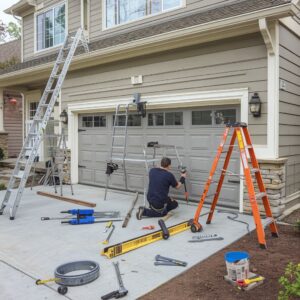
The work itself is quick. A straightforward torsion pair takes roughly thirty to ninety minutes on site, longer if cables, drums or bearings are being done at the same time or if the door needs converting from extension springs.
Evenings, weekends and holidays are where the price moves. After-hours work commonly carries a surcharge in the region of twenty to thirty percent, so if the car is already out and the door is secure, booking the first slot the following morning is often the cheaper call. Ask what the surcharge is rather than assuming.
What to have ready on the phone
Photograph the spring or springs above the door before you dial, plus the whole door from inside. Note whether there is one spring or two, whether the door is single or double width, and roughly how tall it is. Say whether it is wood, steel or insulated, because weight drives spring size. Say if a vehicle is trapped, if the garage is the only entrance, or if nobody in the house can operate the door manually. Those details change both the parts on the van and your place in the schedule.
What a fair quote includes
Ask for a total that covers parts and labour together and the trip charge, so you are not comparing a parts price against somebody else’s all-in figure.
Ask what else is being replaced and why. Cables, bearings and rollers are often genuinely due at the same age as the springs, and doing them while the door is apart saves a second visit, but you are entitled to hear the reason rather than see a line called hardware. Ask for the cycle rating being fitted, and ask what warranty covers parts and labour separately.
A single-door torsion pair commonly lands somewhere around 250 to 450 dollars installed, with heavier doubles running higher. Anything dramatically below that on the phone tends to grow once somebody is standing in your garage.
If you are in Englewood, Venice, North Port, Port Charlotte, Punta Gorda, Rotonda West, Placida or anywhere in Sarasota County, our garage door spring repair service runs same-day and we keep common spring sizes on the van. There is also emergency service outside normal hours when the situation genuinely cannot wait until morning.
FAQ
- Will my homeowners insurance or home warranty pay for this?
- Homeowners insurance almost never covers it, because a spring reaching the end of its service life is wear rather than a sudden covered peril. If a tree or a vehicle damaged the door, that is a different conversation and worth a claim call. Home warranty plans sometimes include garage door hardware, usually with a service fee and a cap, so check your contract before you book, since some plans require you to use their own contractor.
- I rent. Who is responsible for this?
- In most places a garage door is part of the structure and its upkeep sits with the landlord or the management company, not the tenant. Report it in writing rather than by phone so there is a record and a time stamp, note whether a vehicle is trapped, and do not arrange the repair yourself unless your lease says you can and you expect to be reimbursed.
- How long will the technician actually be in my driveway?
- For a standard torsion pair, usually somewhere between half an hour and an hour and a half. The job runs through removing the old springs, fitting the new pair, winding them, balancing the door by hand, and resetting the opener’s travel and force so it is not fighting the new setup. If somebody quotes you fifteen minutes, they are skipping the balance check, and that check is what makes the difference between a door that lasts and a door that comes back.
- My door has extension springs. Should I convert to torsion?
- Often yes, when the headroom allows it. Torsion systems generally last longer, run more smoothly and stay contained on the shaft when they fail, whereas an extension spring can travel if its safety cable is missing or old. Conversion costs more than a like-for-like replacement and takes longer to fit, so it is a decision for the calm version of this situation rather than the emergency one. If you are replacing extension springs today, at minimum make sure safety cables are fitted through them.
- The opener sounded rough while I was trying to open it. Is it damaged?
- Possibly. Ask the technician to test it properly once the springs are correct, since a motor that has been straining against a dead-weight door can have a worn gear, a stretched belt or a stripped drive that only shows up under load. It is much cheaper to find out during the visit than to discover it on the next cold morning, and a healthy opener should move a balanced door quietly and without hesitation.