
Two quotes land in your inbox. One is a few hundred dollars cheaper and can start Thursday, and somewhere in the conversation the words come up — we can do it without pulling a permit, save you the fee and the wait.
It sounds like a small administrative shortcut. It is not. In Florida the permit and the inspection that closes it are the only things that turn a new garage door into a documented one, and documentation is what your insurer prices, what a grant reimburses and what a buyer’s agent asks for. Without them you have a good door with no evidence. Here is the whole process, what it costs in time, and what you are agreeing to when somebody proposes to skip it.
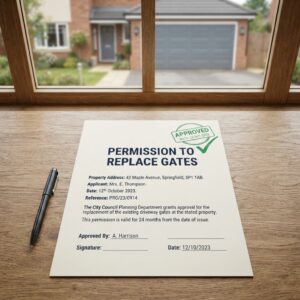
- The permit is not a formality. It ties an approved product to your address, gets the installation verified, and creates a record that outlives the contractor.
- A closed permit and a passed inspection are what let a wind mitigation inspector count the door as protected opening. No record, no credit, whatever door is on the wall.
- State grant money for opening protection is reimbursed against permitted, inspected work. Skipping the permit removes the reimbursement.
- The application needs a Florida Product Approval number matched to your exact opening size and design pressure. That check is why the permit exists.
- The savings on an unpermitted job are usually one to three hundred dollars. What you take on in exchange is fines, a possible retroactive permit, and a disclosure problem at resale.
- The new statewide exemption for small residential work does not clear this job in most cases, and a contractor citing it should be able to say exactly why it applies to your address.
What the permit actually buys you
People assume it is a revenue exercise. It is worth understanding what happens inside the process, because that is where the value sits.
The paper trail your insurer reads
Wind is priced separately on a Florida homeowners policy, and the opening protection line on the wind mitigation form sets that portion. To be counted, an opening has to be an approved product installed to its approval, and the inspector filling out the form has to be able to show it. That form was rewritten this spring and leans considerably harder on documentation than the version it replaced, with photographs and approval paperwork carrying the weight that an inspector’s judgement used to.
A permit record with a passed final is the cleanest answer to whether the door on your house is the door on the paperwork. Without it you are asking an inspector to take a label at face value on an installation nobody verified. Some will, some will not, and the ones who will not are not being difficult.
What the inspector is actually checking
This part surprises people, because the inspection is short and the inspector wants to come inside. They are verifying that the product installed matches the approval submitted, at the size approved, and that it is fastened the way the approval’s installation instructions specify. That means the anchors into the jamb, the number and spacing of track brackets, how the header is attached, and whether anything was substituted.
That is the whole point. A rated door anchored the wrong way performs like the anchors rather than like the label, and the final inspection is the only moment anybody who does not work for the contractor looks at that.
The grant angle, if you are using one
Impact-rated garage doors are eligible under the state’s mitigation grant program, and reimbursement runs against permitted work with a closed-out file. Approval has to come before the work starts and the documentation at the end has to line up. An unpermitted door is not a reimbursable door, however eligible the homeowner was. Our My Safe Florida Home page sets out which parts of that sequence we handle and which stay with the state.
The procedure, start to finish
None of this is complicated and most of it happens without you. Knowing the steps helps you tell whether the company you hired is doing them.
Before anybody applies
The door gets specified first. That means the design pressure required at your address, which comes from the wind speed and exposure category for the lot, and then a product with a Florida Product Approval covering your exact width and height at that pressure. Approvals are size-specific and the limits of use section says so. A model approved to 10 feet wide is not approved at 16 because the manufacturer is the same. Getting this right at the quoting stage is what prevents a failed inspection later.
Application and review
The contractor submits the application with the product approval number, the specification sheet, the installation instructions and the licence and insurance details. Fees for a residential door permit are usually modest, commonly under a couple of hundred dollars including surcharges, and they vary between Sarasota and Charlotte counties and the municipalities inside them. Review on a straightforward replacement is often quick, since there are no plans to examine, and many jurisdictions handle windows and doors as an over-the-counter or online submission that issues within a day or two.
The notice of commencement and the two dollar figures
Here is a detail even trade articles get muddled. Florida’s construction lien law requires a recorded notice of commencement for improvements above 2,500 dollars in contract value, and separately, where the contract exceeds 5,000 dollars, the building department generally has to see proof it was recorded before the first inspection.
On most single-door replacements you are under both figures and the question never arises. On a double door with jamb and header work, or two doors at once, it can apply. The document protects your position against subcontractor liens, it is recorded with the clerk and posted at the property, and your contractor should raise it without being asked.
Installation and the final inspection
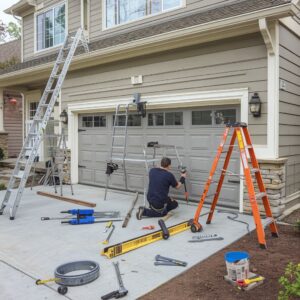
The permit gets posted at the property, the work happens, and the contractor schedules the final. Inspectors generally get there within a few days, sometimes the next working day, depending on season and backlog. The inspector needs access inside the garage, because the fastenings are only visible from in there, so somebody has to be home or the property has to be accessible.
The result is a pass or a correction notice listing what needs changing before a re-inspection. A correction notice is neither a disaster nor rare. What matters is who owns the fix, and in a properly run job the contractor schedules the correction and the re-inspection and you hear about it afterward.
How long it really takes
The honest answer is that paperwork is rarely what holds up a garage door project. Manufacturing is.
A realistic calendar
Specification and quote, a few days. Permit application and issue, often two days to two weeks depending on the jurisdiction and the time of year. Door manufacture and delivery, commonly two to six weeks because a rated door is built to your opening. Installation, most of a day. Final inspection, a few days after that.
So the permit is running in parallel with the door being built, which is why the fee-and-wait framing is usually misleading. The permit is not the thing you are waiting on.
What actually slows it down
An approval number that does not cover the size ordered, which sends the application back. A missing licence or insurance certificate on file. An address inside a municipality with its own building department when the application went to the county. A community with architectural review that has to approve the appearance first. And the ordinary one, a homeowner who takes three weeks to choose a colour. Deciding early is worth more to your timeline than any shortcut on paperwork.
The seasonal squeeze
Everything above stretches from late summer onward. Inspection queues lengthen, manufacturers run long, and after a storm the whole system prioritises damage. A project that takes five weeks in February can take ten in September, and the sixth week is not the permit.
Expert note from the Deluxe Garage Doors technicians
When a company says the permit is optional on your job, ask one question. Ask them to name the exemption they are relying on and put it in writing on the quote. A company that genuinely has an exemption can answer in a sentence. What usually happens instead is a change of subject, and the reason is rarely the fee. Pulling a permit means the contractor’s licence is attached to the address, an inspector will look at the anchoring, and any shortcut in the installation becomes visible. That is precisely the accountability the permit exists to create. We have also been called to correct doors installed without one, and the awkward part of that job is not the work. It is telling a homeowner that the retroactive permit costs more than the original would have and that the first contractor is no longer answering.
What you are agreeing to when somebody offers to skip it
Nobody proposing this describes it as a risk transfer, but that is what it is. Here is the arithmetic.
The savings, counted honestly
The permit fee itself is usually somewhere between fifty and two hundred dollars in this part of the state. Add the contractor’s administrative time and the quoted difference tends to land in the low hundreds. Against that, put the opening protection credit you cannot claim, which for many households runs to several hundred dollars a year and repeats. One year of the credit is often larger than the entire saving, and that comparison settles it for most people.
What transfers to you
The permit obligation attaches to the property owner, not only the contractor, so if code enforcement finds unpermitted work the notice comes to you. That can mean a stop work order, fines that in some jurisdictions accrue daily, and a requirement to permit the work after the fact. Retroactive permitting normally costs more than the original would have, sometimes at a multiple, and it puts the burden on you to demonstrate that work you did not watch was done correctly. If the installer has moved on, that becomes your problem to solve with an engineer.
There is also the claims question. An insurer will not usually void a policy over a garage door, but a wind claim where the door failed and turns out to have been installed without a permit or inspection is a claim with an argument attached, at the worst possible moment.
The new exemption is not the loophole it sounds like
A change to state law this summer requires local governments to exempt certain work on single-family homes valued under 7,500 dollars from the permit requirement, and some contractors have started citing it. Read the carve-outs. The exemption does not cover structural work and does not apply to properties within designated flood hazard areas, which takes in a great deal of this coastline. It also requires a written request submitted to the local enforcement agency with documentation, so it is not simply doing the job quietly, and a project cannot be split into pieces to slip under the figure.
Even where it might apply, ask what you gain. The permit is what produces the record your insurer, your grant file and your future buyer want. Being allowed to skip the paperwork does not make the paperwork worthless.
Selling a house with an unpermitted door
This is where the shortcut presents its bill, often years later and to somebody who did not authorise it.
How it surfaces
Title companies and lenders check for open permits, and a job with no permit at all shows nothing open, which people sometimes take as good news. It surfaces elsewhere. A buyer’s agent asks for the wind mitigation report and the opening protection line is weak. An inspector notes a newer door with no permit history at the county. A buyer asking for the insurance paperwork gets nothing. In a market where hurricane hardening is a live question, a door that cannot be documented becomes a negotiating point rather than a selling point.
Getting it permitted after the fact
It is usually possible and rarely pleasant. You apply for a permit for work already completed, the department may require an engineer’s letter or an affidavit, and the inspector still needs to verify the fastening, which can mean removing trim or partially disassembling to expose anchors. Timing is the sharper problem, since this runs on the county’s calendar rather than your closing date, and it is a poor thing to discover during an inspection period.
Disclosure
Florida sellers have a duty to disclose facts materially affecting value that a buyer cannot readily observe. Unpermitted work generally falls in that category, and answering a disclosure form about permits requires knowing what was done. The practical advice is simple. Keep the permit number, the approval documents, the inspection record and photographs of the installation in the same folder as your insurance paperwork. That folder answers every question a buyer will ask, and it is worth real money at the table.
Choosing a contractor by the paperwork
You can sort a field of quotes on this subject faster than on price, and the answers tell you more.
Five minutes of questions
Ask for the Florida Product Approval number of the specific door proposed, at your exact width and height. A company that has done this before has it ready. Ask who pulls the permit and whether the fee is in the quote or added later. Ask whether the quote covers jamb, header and track anchoring to the approval’s installation specification, or only the door. Ask who schedules the final inspection and who attends, and what you receive at the end.
Then verify the licence at the state’s licensing site and check that the insurance certificate names the company you are actually hiring. It takes a few minutes and it is the cheapest due diligence available.
What you should be holding at the end
The permit number and the record showing it closed. The product approval documents for the door installed. The manufacturer’s installation instructions. Photographs of the anchoring before any trim went back on. The warranty, with parts and labour stated separately.
That set is what a wind mitigation inspector wants, what a grant file needs, and what a buyer’s agent will ask for. If a contractor cannot tell you which of those you will receive, that answer is itself informative.
Our hurricane garage door installation service handles the specification, the approval documentation, the permit and the inspection as one job across Englewood, Venice, North Port, Port Charlotte, Punta Gorda, Rotonda West, Placida and Sarasota County. If you are comparing quotes and want a second read on what one of them is actually including, request a quote and ask us that directly.
FAQ
- Can I pull the permit myself instead of paying a contractor to do it?
- Florida allows an owner-builder exemption on your own one or two family home, with conditions. You generally have to appear at the building department in person, sign a disclosure acknowledging that you are acting as your own contractor, and the work must be for your own use rather than for sale. Some jurisdictions limit how often an owner-builder permit can be issued to the same person. It is a real option and it comes with real responsibility, since the liability for the installation sits with you rather than with a licensed company.
- A previous owner left an open permit on the property. What does that mean for me?
- It means work was permitted but never inspected or closed out, and it will surface in a title search. Open permits can hold up a sale or a refinance and they occasionally have to be resolved before a new permit is issued on the same property. The route is usually to contact the building department, find out which inspection was never completed, and either arrange it or apply to close the permit with an affidavit. It is worth checking your own address for these before you need to.
- Do I need a permit to replace one damaged section or just the opener?
- Generally an opener swap does not require a building permit, though electrical work to add a circuit would. A single section replacement sits in a grey area and is treated differently between jurisdictions, partly because swapping a section can move the assembly away from its approved configuration. Call the building department before the work rather than after, because the answer takes two minutes and an unpermitted change to a rated door creates the same documentation gap as an unpermitted door.
- Will pulling a permit raise my property taxes?
- A like-for-like door replacement is maintenance rather than an addition, so it does not normally trigger a reassessment on its own. Property appraisers do receive permit data, which is why the question comes up, but what moves an assessment is added square footage or a substantial improvement. Your county property appraiser is the authority if you want certainty.
- If the door fails inspection, who pays for the re-inspection?
- On a contracted job the contractor does, and any reputable quote treats corrections and re-inspection fees as their cost rather than a change order. Ask about it before you sign, since it is a fair question and the answer tells you how the company handles its own mistakes. If you pulled the permit yourself as an owner-builder, the fees and the corrections are yours, which is one of the trade-offs of that route.