
The manual that came with your door was written for a house in Ohio. It tells you to lubricate annually and check the balance now and then, and in most of the country that is fine advice. On Manasota Key it is about half of what the door needs.
Out here the panels almost never wear out first. What fails is everything that moves — rollers, hinges, cables, springs, bearing plates, the fasteners holding the track to the jamb. Salt gets into all of it quietly, so the first sign is usually a noise or a cable that lets go on a Tuesday morning. This is what keeps a coastal door alive, in the detail the manual leaves out.
- Salt does not need rain or spray to reach you. Chloride carries inland on the breeze and pulls moisture out of humid air onto the metal, so corrosion runs even through a dry week.
- A plain fresh-water rinse is the highest-value thing you can do, and it has to include the back and underside of the door, where salt collects and rain never reaches.
- Lubricant is two products, not one. White lithium grease belongs on metal that rides on metal. Silicone belongs on seals and plastic. Tracks get cleaned rather than greased.
- Cables and springs are the parts where corrosion stops being a maintenance question and becomes a safety one, and both fail from the bottom few inches upward.
- If you close the house for the summer, the door needs ten minutes of attention before you fly out and a careful check before you use it again.
- Hardware grade matters more here than anywhere else. Galvanized, powder coated and stainless components cost a little more once and save a service call a year.
What salt actually does out here
Understanding the mechanism makes the routine make sense, and it takes about a paragraph. Salt is not simply dirt that happens to be corrosive.
Chlorides, humidity, and corrosion without rain
Wind off the Gulf carries fine chloride particles inland, and they land on everything. They settle on the front of your door, drift through the gap under it, and coat the hardware inside the garage as well.
Then humidity does the rest. Salt is hygroscopic, so it pulls water vapour out of the air and holds it as a film against the metal. That film is an electrolyte, which is exactly what an electrochemical reaction needs to run. The metal is effectively sitting in salt water even on a bright dry day in April, and the reaction never really stops. That is why a door on Manasota Key or out toward Placida ages differently from the same door three miles inland.
The parts that give up first
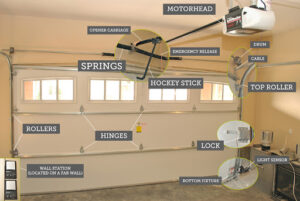
Roller stems and their bearings go early, because the bearing is a tight metal-on-metal space where salt collects and lubricant thins out. The symptom is a grinding or chattering sound as the door travels. Hinge pins seize inside their barrels, which makes the sections fight each other at every joint. Bearing plates at the ends of the torsion shaft dry out and squeal. Fasteners lose thread engagement in a jamb that has been damp for twenty years, so a screw turns without ever tightening.
Cables are the ones to take seriously. They corrode from within the lay of the wire, so a cable can look acceptable from four feet away and have lost a serious share of its strength.
Where salt collects that nobody looks
Front of the door, everybody thinks of. The places that matter are less obvious. The bottom section, inside and out, sits closest to the slab where salty water pools after a storm. The inside face collects a film that never gets rinsed by anything. The tracks, especially the horizontal run back into the garage. The drums at each end of the shaft where the cable winds. And the bottom brackets, which hold the cable within an inch of the floor. If you only ever clean one area, make it the bottom eighteen inches, inside and out.
The rinse, done the way it should be
This is the cheapest maintenance in this article and the one that buys the most time. It also gets described badly almost everywhere, usually as a vague instruction to hose the door off now and then.
How often, by how close you are
Direct Gulf frontage, a barrier island lot, or a house where you can taste salt on the air most mornings — every two to four weeks. A canal or bay lot, or anywhere within roughly a mile of open water — monthly, and every two weeks through the windier months. A mile or two inland with buildings and vegetation in between — every six to eight weeks, plus after any storm that came off the Gulf regardless of the calendar.
Rain does not count as a rinse. It hits the front of the door and nothing else, and it often leaves salt concentrated at the bottom edge as it dries.
The method, and why a pressure washer is wrong
Plain fresh water from a garden hose. No detergent needed for a routine rinse, though a mild car soap a couple of times a year does the finish good. Do the front, the frame, the tracks and the visible hardware, then go inside and do the back of the door and the bottom section. Let it drain and dry before you lubricate anything, because grease over a wet surface traps the water underneath it.
Leave the pressure washer in the shed. High pressure drives water into roller bearings, into the seams between sections, into the opener electronics and behind the weatherstripping, which is precisely where you do not want moisture sitting. It also strips whatever protective coating is left on the hardware.
The slab and the seal
After you rinse the door, rinse the concrete in front of it and just inside. Salt residue on the slab keeps the bottom bracket and the lowest few inches of cable in a damp salty environment long after the door is dry. Check the bottom seal while you are down there. When the rubber goes hard and stops meeting the floor across its full width, salt air moves in and out all day and everything in the garage ages faster, including the tools and the second car. A seal is inexpensive and it does more work than it looks like it does.
Lubrication — two products, not one
Almost every maintenance list says silicone or lithium as though the two were interchangeable. They are not, and the wrong one in the wrong place is how people end up with a door that runs worse after they serviced it.
White lithium grease for metal riding on metal
Hinge pins, roller stems, the coils of the torsion spring, the bearing plates at each end of the shaft, and the opener’s chain or screw drive. These are load-bearing metal contacts and they want a grease that stays put and repels water. Apply lightly and wipe the excess, because excess grease is not extra protection but a magnet for the fine sand that gets into every garage on this coast, and grit in a bearing does more damage than dryness. Every three months is a reasonable interval near the water; inland you can stretch it to six.
Silicone for seals, plastics and weatherstripping
Rubber and vinyl want silicone, not petroleum products, which soften and eventually break rubber down. The bottom seal, the side and top weatherstripping, and any plastic components belong in this category. A silicone spray on the bottom seal a couple of times a year keeps it flexible, stops it sticking to the slab in summer and extends its life by years. It is a two-minute job that people skip because nobody tells them to do it.
What not to use, and what not to lubricate
The all-purpose spray in the blue and yellow can is a water-displacing solvent. It has a legitimate use here, driving water out of hardware that has been soaked or freeing something seized before you clean it, but it is not a lubricant to leave in place. It thins, it carries away the grease that was there, and within weeks you are worse off.
Do not grease the tracks. They are a rolling surface rather than a sliding one, and anything sticky on them collects sand and turns into an abrasive paste that chews rollers. Wipe them with a dry cloth instead. And leave the cables alone — they are inspected, not lubricated, and anything you put on them makes an honest inspection harder.
Expert note from the Deluxe Garage Doors technicians
The tell we look for on a coastal call is rust bleeding out from under a bracket rather than rust on the surface of one. Surface rust on a track or a hinge is cosmetic and normal here. A brown stain running down the jamb from behind a bracket means the corrosion is happening in the joint, under the part, where you cannot see it and cannot treat it, and that fastener has usually lost most of its grip. The second tell is the sound of the door on the way down. Coastal doors get noisy on the descent before they get noisy on the way up, because that is when the roller bearings carry the weight differently. If your door has started announcing itself in the evening and it did not used to, that is the rollers asking for attention while replacing them is still cheap.
Hardware that actually survives here
At some point maintenance stops being enough on its own and the answer is better parts. The upgrade is cheap when it happens during work you were doing anyway.
Galvanized, powder coated and stainless
Galvanizing puts a zinc layer over the steel, and the zinc corrodes first, sacrificially, buying the steel underneath real time. It is the sensible baseline for springs, tracks and brackets anywhere near the water. Powder coating is a baked-on barrier that looks better for longer, though a chip concentrates corrosion at that point and wants more inspection.
Stainless is the top of the range, and grade matters. Grade 316 contains molybdenum and handles chlorides considerably better than grade 304, which is the usual builder-grade stainless. On a Gulf-front or island house, 316 fasteners and brackets are worth the difference, and the upgrade adds a modest amount per component against a service call a year.
Rollers and the bearing question
Nylon rollers with sealed steel bearings are the right choice for this climate. The nylon runs quieter and does not corrode, and the sealed bearing keeps salt out of the part that actually wears. The distinction to insist on is sealed, because plenty of nylon rollers ship with open bearings that look identical on the shelf and last a fraction as long here. Ask specifically, and ask about bearing count while you are at it.
Two metals touching, which nobody mentions
Put dissimilar metals in contact with salt water between them and you get galvanic corrosion, where the less noble metal corrodes far faster than it would alone. This matters on aluminum doors, which are popular here for good reason. Fit plain steel fasteners or brackets to an aluminum door in a salt environment and the aluminum starts eating itself around every fastener, and the same applies to stainless hardware bolted straight to aluminum without isolation.
You do not need to become a metallurgist. You need whoever works on the door to specify hardware that matches the door material, and to ask the question if somebody proposes mixing them.
Closing the house for the summer
A great many houses on this coast sit empty from May to October, and the door that gets no use is not the door that suffers least. Standing still has its own problems.
The week before you fly north
Rinse the door properly, front and back, let it dry, then lubricate everything. Fresh grease sitting on clean metal for six months is doing exactly what you want. Silicone the bottom seal, because a seal left compressed against a hot slab through a Florida summer will stick and tear the first time the door runs in the autumn. Check the balance by releasing the door and lifting it halfway by hand, and if it does not hold position, sort that before you leave rather than discovering it in November.
Pull the plug on the opener or switch off its breaker. Take the battery out of any wall keypad, because a leaking battery in a hot garage makes a mess of the contacts. And do not leave the door propped open for ventilation. It invites weather, wildlife and attention.
Six idle months
If somebody checks the house, ask them to run the door through a full cycle once a month. It costs two minutes and it keeps the grease distributed, the seal from bonding to the slab and the opener from seizing. Ask them to look at two things while they are there — whether the bottom seal still sits flat, and whether any new staining runs down the jamb from the track brackets.
Rodents and wasps are the other summer visitors. A nest behind a bearing plate is more common than you would think, and a nest in the opener housing is a repair rather than a clean-up.
The day you get back
Do not just press the remote. Release the door and move it by hand a few feet to feel whether anything binds. Check that the bottom seal has not welded itself to the concrete, and if it has, work it free by hand rather than letting the opener tear it. Look at the cables at the bottom brackets and the drums for rust or broken strands, and at the springs for a gap.
Then rinse, dry, lubricate, and only then use it normally. Ten minutes on arrival day saves a great many first-week service calls, which is also the week everybody else on the island is calling.
When corrosion has gone too far
Some of this is maintenance and some is past that point. Knowing the line keeps you from spending money on parts that cannot be saved and, more importantly, from trusting parts you should not.
Cables and springs are safety parts
A cable with broken strands, rust bloom at the drum, or a flattened section near the bottom bracket is not something to watch. It is replaced. Cables fail suddenly and under load, and they take the door out of square when they go.
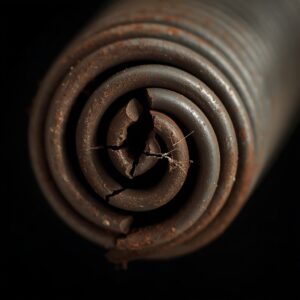
Springs with rust between the coils have lost cycles they will not get back. A spring that squeals despite being greased, or that shows a rough orange texture rather than a clean coating, is on borrowed time, and replacing it on a scheduled visit costs considerably less than on a Saturday. Our spring repair page covers that work. Neither part is a homeowner job, since both are under high tension.
Track pitting and section rot
Run a fingertip along the inside of the track where the rollers ride. Smooth, even with some surface rust, is fine. Rough, pitted or flaking means that surface is now grinding your rollers, and lubricant cannot fix a surface. Tracks are replaceable and not especially expensive, so this is good news rather than bad.
The section joints are the harder call. Corrosion inside the end stiles or along the bottom section’s return edge is structural, and a soft bottom section cannot be restored. On a door that is otherwise sound and reasonably new, a single section can often be replaced. On an older door, that repair is money spent on the way to a replacement anyway.
Repair, upgrade or replace
The honest framing is this. Hardware corrosion is a repair, and usually a good-value one, because rollers, hinges, cables, bearings and tracks are all replaceable and the upgrade to coastal-grade parts happens at the same time. Panel and stile corrosion is a different conversation, because that is the door itself. When fasteners no longer hold in the sections, when the bottom section flexes where it should be rigid, or when you are replacing hardware for the third time on a twenty-year-old door, the arithmetic has moved.
If you want somebody to tell you which side of that line you are on, that is what our garage door repair and inspection visits are for. We work across Englewood, Venice, North Port, Port Charlotte, Punta Gorda, Rotonda West, Placida, Manasota Key and Sarasota County, and we would rather quote you rollers and a track than a door you do not need yet.
FAQ
- Should I wax the door panels the way I wax a car?
- On a painted steel or aluminum door, yes, and it helps more here than most places. A coat of automotive paste wax twice a year gives the finish a barrier that salt has to get through first, and it makes the routine rinse more effective because less residue clings. Do the panels and frame, keep wax off the tracks and weatherstripping, and pick a cooler part of the day so it does not flash off before you buff it.
- Does an insulated door corrode more or less than a single-skin one?
- The panel itself usually does better, because a sandwich section has a steel skin on both faces and is stiffer, so it flexes less and the finish cracks less. What changes is the weight, which puts more load on rollers, cables and bearings, and those are the parts salt attacks. An insulated door on the coast is a good choice that raises the importance of hardware grade rather than lowering it.
- I rinse my boat and fishing gear in the garage. Is that a problem?
- It is, and it is one of the more common sources of corrosion we find on the inside of a door. Rinsing salt-covered gear indoors puts chloride-laden mist onto every metal surface in the space, springs and opener included, with little airflow to carry it out. Rinse outside where you can, keep gear off the floor near the bottom brackets, and if it has to happen indoors, leave the door open afterward until everything is dry.
- My door was installed with a coastal hardware package. Do I still need the routine?
- Yes, though you can relax the pace. Better hardware slows corrosion rather than stopping it, and the sacrificial coatings doing the protecting are consumed over time, which is the point of them. Keep rinsing, watch the cables and the bottom seal, and treat the upgrade as a wider margin rather than an exemption.