
Most people in Englewood, Venice and Port Charlotte have already spent money on the parts of the house they can picture failing. A new roof after Ian. Impact glass on the west elevation. Straps, a generator, a surge pump. Then another storm comes through, the roof deck lifts anyway, and the adjuster walks to the front and points at the one opening nobody touched.
The garage door is the largest hole in your exterior wall, and in most homes here it is the only opening still carrying its original hardware. This article walks that failure through in order and turns it into a decision you can make this month.
- A two-car garage door is roughly 112 square feet of unreinforced wall, several times larger than any other opening in the house. When it goes, interior pressure pushes up on the roof deck at the same moment the wind outside pulls it, and the roof was engineered for only one of those forces.
- Florida’s code lets garage doors be designed to about 60 percent of the pressure every other opening must meet. During Milton, fully compliant DP 36 doors were still where roof damage started.
- A wind rating and an impact rating are two different purchases. On this coast, debris is usually what opens a door that would have held on pressure alone.
- One unrated garage door can wipe out the whole opening protection credit on your wind mitigation form, even with impact glass everywhere else. Grants, permits and lead times all run on weeks, so August work finishes before the busiest stretch of the season.
The largest hole in your house is the one you drive through
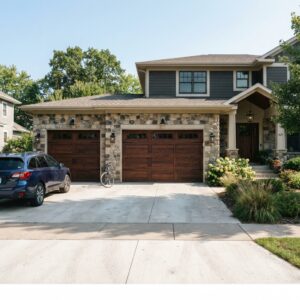
Look at your front elevation the way wind looks at it. On a typical single-story here, the garage door is between a third and a half of everything facing the street. The rest is block, and block does not fail at 130 mph. The door does.
The numbers are worse than they feel
A two-car door at 16 by 7 feet is about 112 square feet. A single-hung window is roughly 15. A large slider is 40 to 60. The garage door is not slightly bigger than the next opening; it is several times bigger, and it is one continuous surface, so nothing about it is redundant.
Put a load on that. A sustained pressure of 30 pounds per square foot across a 16-foot door is more than 3,300 pounds pushing inward, about a full-size pickup leaning on your panels. In a major hurricane it passes 4,000, and nothing has to hit the door for that to happen.
What newcomers from the north tend to miss
Northern garage doors are engineered for weight and insulation. Snow load, cold, R-value on the sticker. None of that speaks to lateral pressure, and none of it addresses a roof tile arriving at 90 mph.
The habits travel too. Up north the garage is the room you stop maintaining. Here the door is a structural part of the envelope, tested to a pressure standard, listed in a state approval database and inspected by your insurer. The tell in recently bought homes is a new roof, new impact windows, and a builder-grade door from the nineties between them.
What actually happens in those few seconds
There is no explosion. There is a sequence, it takes seconds, and each step makes the next one easier.
The panel bows and the rollers leave the track
Wind loads the door across its whole face, and residential panels resist by flexing. Some deflection is designed behavior; a lot of it means load is transferring to the ends, where the rollers sit.
That is where most doors actually fail. As the panel bows, roller stems pull inward and the vertical tracks rotate. Rollers pop out. Once two or three are gone the panel has nothing holding its edges, and it folds. This has been the documented failure mode since Andrew, and it is why track anchoring matters more than panel thickness.
The house pressurizes and the roof deck lets go
Now the garage is open. It is typically 400 to 600 square feet with a direct door into the living space, and hurricane wind fills it. Interior pressure climbs to roughly 30 to 60 pounds per square foot.
Outside, that same wind generates suction on the roof, perhaps 40 to 80 pounds per square foot at the edges and corners. Those forces do not cancel. They add. The roof is pushed from underneath and pulled from above in the same instant, and combined uplift can pass 100 pounds per square foot above the garage.
Roof systems are sized on the assumption that the envelope stays closed. Decking separates at the garage first, wind reaches the attic, and the attic runs the length of the house. What began at one opening ends as a roof claim, a ceiling claim and a contents claim.
The code gap that catches even careful owners
Homeowners who have done everything right are often the most surprised here, because the door that failed was legal, permitted and inspected.
Sixty percent of the number every other opening has to meet
Florida Building Code Section 609.4 lets garage doors be designed for about 60 percent of the wind pressures ASCE 7 calculates for the site. Windows and entry doors get no such allowance. The result is a house with windows rated to DP 50 and a door between them rated to DP 36.
Milton put that reasoning under strain. A University of Florida team led by David Prevatt assessed 120 homes in the tornado paths that storm produced in October 2024. In the Cobblestone neighborhood in St. Lucie County, built in 2019 and later with impact windows and proper roof connections, only two houses had structural roof damage. Both had garage doors facing the tornado, both rated DP 36, both code-compliant. Debris from older roofs upwind, plus pressure, breached them, and roof decking lifted. Every other modern home there came through intact. The researchers called garage doors damage amplifiers.
Wind rated and impact rated are not the same purchase
A wind-rated door resists pressure. An impact-rated door resists pressure and debris, having been tested against a missile, commonly a nine-pound two-by-four, then cycled thousands of times to simulate a storm’s duration. That distinction decides outcomes here. Most of the Sarasota and Charlotte shoreline sits in the wind-borne debris region — within a mile of mean high water where design wind speed reaches 130 mph, plus anywhere it reaches 140. Much of our service area is mapped at 150 mph or higher, and barrier island lots on Manasota Key and Casey Key pick up Exposure D off open water, which raises pressures again. Inside that region your neighbor’s roof is your projectile source.
The ninth edition of the code takes effect December 31 and moves the state onto ASCE 7-22, tightening the calculations garage doors fall under. A door that only just clears today’s minimum is the bottom of a rising standard.
Ten minutes with a flashlight tells you where you stand
You do not need an inspection to find out whether you have a problem. You need a flashlight, a phone camera and a step stool.
Find the label and look behind the panels
Close the door and check the inside face, usually on the bottom or second panel near an edge. A rated door carries a permanent label with the manufacturer, model, tested dimensions and design pressure, plus a Florida Product Approval number written as FL followed by digits. No label means no rating in practice, and doors installed before 2002 essentially never carry one.
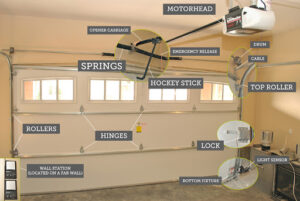
Then shine the light across the back. You want horizontal struts running the full width of each panel. A rated door usually has them on most panels; a builder-grade door has one on the top panel and nothing else. Follow the vertical track down to the floor, looking for elongated bolt holes, rust around fasteners and brackets pulling away from the jamb. Push the track sideways. It should not move.
Verify the number instead of trusting the sticker
Look the approval up at floridabuilding.org. Confirm it is current, that it covers your door’s actual width and height, and whether it is impact rated or wind-load only. Approvals are size-specific — a model rated at 9 feet wide is not automatically rated at 16.
Check the installation too. A rated door installed with the wrong anchors is rated on paper and builder-grade in a storm. Salt air sharpens this near the water, where hinge pins and track fasteners lose capacity while the panel still looks fine.
Expert note from the Deluxe Garage Doors install crew
On a service call we can usually tell in under a minute whether a door will hold. We put a flat hand in the middle of the second panel up from the floor and push. If it moves more than a fingertip’s worth, there is no strut behind that panel. Then we look at where the vertical track meets the jamb, because that is where the trouble lives. On a lot of Englewood and Rotonda West homes the track is held by two lag screws driven into a jamb that has been breathing salt air since the eighties. Pull one out and the threads come with it as powder. The fastener fails before the panel does.
Three options, priced honestly
There are three real answers here, and they buy different things.
Bracing, and what it does not do
A bracing kit adds posts or bars tying the door back to the slab and header, cutting deflection and making track separation less likely. Installed, usually 300 to 800 dollars.
It adds no impact resistance and does not improve the substrate — bracing a corroded 1997 door reinforces a corroded 1997 door. Most kits are not approved products, so they generally will not satisfy opening protection on your insurance paperwork, and some must be installed by hand before each storm, which is useless if you are out of state in September.
Wind-rated and impact-rated replacement
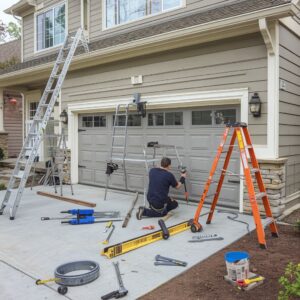
A wind-rated door is a system — reinforced panels, heavier steel, integral struts, heavy-duty tracks, upgraded rollers and specified anchors, certified for your wind zone and exact opening. Installed, roughly 1,200 to 3,000 dollars for a single and 2,000 to 6,000 for a double. It solves pressure completely and debris not at all.
An impact-rated door meets the pressure standard and passes missile testing on top of it, generally 2,500 to 4,500 dollars for a single and 4,000 to 10,000 for a double. Near the water in Sarasota or Charlotte County that is the version matching the hazard, and the only one that lets the garage count as a protected opening. Our hurricane garage door installation service handles the specification, approval documents, permit and wind mitigation paperwork as one job.
Money, timing and the decision itself
This is where the garage door moves from someday to this month, because two separate pots of money point at it and both run on a calendar.
Grants and the all-or-nothing line on your insurance form
Impact-rated garage doors are eligible under the state’s grant program — a free wind mitigation inspection plus a matching grant of up to 10,000 dollars, with the state adding two dollars for every one you spend for most applicants, and qualifying low-income homeowners covered with no match. Funding is first-come, first-served and past cycles emptied quickly, so mysafeflhome.com is the authority on current terms. Our My Safe Florida Home page explains our part. Approval must come before work begins.
Separately, the opening protection section of the wind mitigation form records the weakest protection on the whole structure, garage door included. That word does enormous work. A house with impact glass everywhere and one unrated door gets no partial credit; it drops toward the bottom of the scale. The form was rewritten this spring and now wants photographs and product documentation rather than an inspector’s judgment, so an illegible label is harder to excuse. After the work, order a new inspection and send it to your carrier, because the credit is not applied automatically.
If you are buying a house here
The four-point inspection covers roof, electrical, plumbing and HVAC. The garage door is not in it. If the seller has a recent wind mitigation report, read the opening protection line, and if the rating sits at the bottom, ask which opening caused it. It is frequently the garage. Otherwise run the flashlight check yourself during the inspection period.
An unrated double door in a debris region is a known expense of roughly 4,000 to 10,000 dollars and a live insurability question, which makes it a negotiating line item rather than a vague worry. Get a written quote before your objection deadline, then move the price or have the work done before closing.
Where to start this month
Ian, Charley, Helene and Milton all arrived between mid-August and mid-October. That is climatology, not coincidence. Do the flashlight check today, get a written quote with the design pressure spelled out for your opening size, check grant eligibility before work starts, then book with lead time and permit review in the schedule.
Four questions separate a company that has done this from one that has not. The Florida Product Approval number of the specific door at your width and height. Whether the quote covers jamb, header and track anchoring to that approval’s specification. Who pulls the permit. What documentation you receive for your insurer and grant file. Our team answers all four as part of the job.
FAQ
- Can I get a hurricane-rated garage door installed once a storm is already in the Gulf?
- Realistically, no. A rated door is built to your opening’s dimensions, so there is manufacturing and delivery time before anyone touches the house, and the permit has to be reviewed. Building departments also suspend inspections as a storm approaches. Plan on weeks from the day you sign.
- My community has deed restrictions on exterior appearance. Does that limit my options?
- It limits appearance, not performance. Rated doors come in raised-panel, carriage-house and flush profiles in a wide range of colors, so an architectural board’s rules and a design pressure requirement rarely conflict. Submit the manufacturer’s product sheet with your application and get approval in writing before ordering.
- Will a heavier impact-rated door wear out my existing opener?
- The opener is not carrying the weight, the springs are. A heavier door needs a different spring specification, and that belongs in the installation rather than in an upsell. A correctly balanced door holds position when you disconnect the opener and lift it halfway by hand, so check that before final payment.
- Is a garage door with windows in it a bad idea here?
- It changes the category. Glazing turns the door into a glazed opening on the wind mitigation form, so the glass itself must be impact rated for the door to count as protected. Decorative inserts do not qualify, so specify impact glazing from the start.