
Almost every conversation we have about hurricane readiness reaches the same fork. Somebody has read that the garage door is the weak point, they believe it, and then they ask whether the door already on the wall can be made good enough for a few hundred dollars instead of a few thousand.
It is a fair question and it deserves a real answer rather than a sales one. Sometimes reinforcement is the right call and we say so. Sometimes it is money you will never see again. The difference comes down to what your door is made of, where your house sits, and one piece of arithmetic that most comparisons leave out entirely.
- Reinforcement is three different jobs that get sold under one word. Struts on the panels, upgraded track and jamb anchoring, and removable storm bracing solve different problems and cost different money.
- Reinforcement works well on a sound door where the weakness is the anchoring. It works badly on anything corroded, rotted, bent or already straightened, because the added hardware has nothing solid to hold.
- No amount of bracing adds impact resistance. If flying debris is your real hazard, and along this coast it usually is, reinforcement is treating the wrong problem.
- Only a permitted, inspected replacement with a Florida Product Approval gets recorded as protected opening on your wind mitigation form. Reinforcement almost never does, which means it returns nothing annually.
- That recurring credit, plus a state grant that can carry two thirds of the project, drops the real cost of replacement well below the sticker figure. Reinforcement has no equivalent.
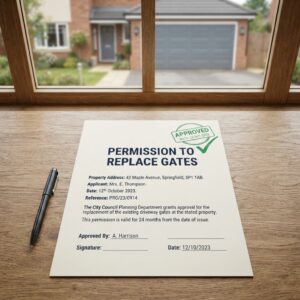
- The new statewide permit exemption for small residential work does not cover this job. The permit is what creates the record your insurer and any future buyer will ask for.
Three different jobs share one word
When two companies quote you reinforcement, they may be describing completely different work at completely different prices. Sorting that out first saves an argument later.
Struts and hardware on the door itself
The lightest version adds horizontal steel struts across the back of panels that do not have them, sometimes with heavier hinges and longer roller stems. On a double door that is usually four to six struts, and the work runs roughly 250 to 700 dollars depending on how many sections need doing and how much hardware goes with them.
This genuinely reduces how far the panels flex under pressure. What it does not do is turn a light panel into a heavy one. The steel skin stays the gauge it always was.
There is a side effect worth knowing about. Struts add weight, and the springs were sized for the door as it was. A reinforced door that no longer holds position halfway up needs its springs adjusted, and that is part of the job rather than an extra to be discovered afterward.
Track, brackets and the jamb behind them
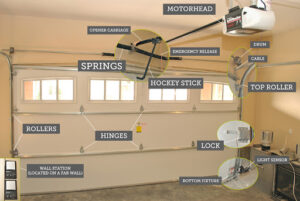
The second version is where most of the real value sits, and it is the one that gets skipped. Adding jamb brackets, replacing light fasteners with proper anchors into the block, reinforcing or replacing a tired wood jamb, and tightening the whole track assembly to the building typically costs 200 to 600 dollars.
Doors mostly fail at the edges. The panel bows, the end stile twists, the roller leaves the track and the door folds inward from the side. Everything that keeps the track attached to the wall is working against that sequence directly. If you only have money for one thing, this is usually the thing.
Removable storm bracing
The third version is a post system that goes in before a storm and comes out afterward, anchored into sleeves set in the slab and a receiver on the header. Kits run roughly 150 to 500 dollars for a double door, and setting the anchor points properly adds to that. Two limits matter. Somebody has to be home to fit the posts, which does not suit anyone who spends part of the season out of state. And a brace that only props the door from inside leaves it exposed to suction, the larger of the two loads on most residential openings, so a system that fastens to the door itself is the one worth buying.
When reinforcing is a sound decision
There is a real category of house where we recommend reinforcement and mean it. It is narrower than the internet suggests, but it exists.
The door is young and the metal is honest
If the door went in within the last ten or twelve years, the panels are clean steel with no corrosion at the bottom section, the hinges are tight and it has never been hit, you have a substrate worth spending money on. Reinforcement attaches to what is already there, so what is already there decides the outcome. Press the middle of the second section with a flat hand while the door is closed, then run a screwdriver tip gently along the bottom section and the inside face of the jamb. Firm steel and firm wood means the answer might be yes.
The weakness is the anchoring rather than the panels
This is the sweet spot. A decent door with two brackets per side, screws loosened over fifteen summers, and a jamb never anchored properly into the block behind it. The door is fine; the connection to the building is not. That work is real engineering with a real result, it costs a few hundred dollars, it can be done in a morning, and it improves how the door runs day to day.
If your door already carries a rating
Some homeowners discover, after actually looking, that the door has a label and a design pressure on it. If that is you, replacement may be pointless and the real job is smaller — confirm the approval covers your opening size, add whatever struts the drawings call for and the installer skipped, bring the bracket count up to specification, and photograph it all for your insurer. That conversation costs an hour and possibly nothing else, and we would rather have it than sell you a door you do not need.
When the money disappears
The other side of the honesty is knowing which doors cannot be saved with hardware, because reinforcing them produces a stronger-looking door with the same real capacity.
Corrosion, rot and anything already bent
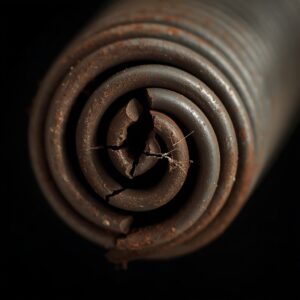
Within a couple of miles of Charlotte Harbor, Lemon Bay or the Gulf, salt works on the parts you do not see. A bottom section blooming rust, hinge pins seized in their barrels, cable strands parting at the drums, a jamb that takes a screw without ever tightening — none of that is fixed by adding steel on top. The same applies to any door backed into and straightened. Once a panel has creased, the fold is a permanent hinge, and pressure finds it again.
Wide openings with light end stiles
A 16-foot door carries roughly twice the load of an 8-foot one across a single span, and it does it through the same end stiles. On builder-grade doubles those stiles are thin folded steel, and no amount of horizontal strutting changes how they twist. If the door is wide, light and original to a house built before the code, put the reinforcement budget toward the replacement instead of ahead of it.
When debris is the actual hazard
This is the one that decides most cases here. Bracing and strutting address pressure. They do nothing about a piece of somebody else’s roof arriving at speed.
Most addresses along the Sarasota and Charlotte coast sit inside the wind-borne debris region, and the case studies from recent storms keep showing the same thing — doors that met the pressure requirement were breached by debris first, and the roof followed. If you are in that region and you spend a thousand dollars on reinforcement, you have bought a stronger door with the same vulnerability to the thing most likely to open it.
Expert note from the Deluxe Garage Doors technicians
We turn down reinforcement work fairly often, and it is nearly always for the same reason. The customer asks for struts, we put a screwdriver into the jamb, and it goes in like the wood is not there. At that point adding hardware means fastening steel to something soft, which feels reassuring and carries nothing. The other tell is a door that has been fine for twenty years, because doors that old were built to a different weight. We would rather quote the jamb, the brackets and the anchors on a good door than sell struts for a tired one, and if the honest answer is that the door has reached the end, we will say that too. It is a shorter conversation and a cheaper one for us, but you only find out whether a company tells you the truth once, and it is usually the day after a storm.
The arithmetic that most comparisons leave out
Here is where the comparison stops being a straight price difference. Reinforcement is a cost. Replacement is a cost with a return attached, and the return arrives every year.
Only a permitted replacement gets recorded
Your homeowners policy prices wind separately, and the opening protection section of the wind mitigation form sets that part of the premium. To count as a protected opening, a garage door has to be an approved product, installed to its approval, under a permit that was inspected and closed.
Bracing kits and strut work generally do not satisfy that. A few retrofit products carry a state approval and it is worth asking, but most reinforcement leaves your form exactly where it was. The practical difference is not 700 dollars against 4,000. It is 700 dollars that returns nothing against 4,000 that comes back in slices.
What the credit is actually worth
You will read that a rated door cuts your premium by 30 percent. Treat that carefully. The opening protection credit applies to the wind portion of the premium rather than the whole bill, and it only reaches its top level when every opening on the house qualifies, glazed and non-glazed alike.
Program reporting on state-funded mitigation work gives a more grounded picture. Around half of participants report an insurance saving at all, and the average reported saving sits near a thousand dollars a year. That is a real number rather than a marketing one, and on a four thousand dollar door it still implies the premium alone repays the project inside about four years, with everything after that being money you keep.
Two conditions attach. The credit is not applied automatically, so you order a fresh wind mitigation inspection after the work and send the form to your carrier. And the form lapses after five years, which nobody at the insurance company will remind you about.
The new permit exemption does not help you here
A change to state law this summer lets owners of single-family homes skip a building permit for qualifying work valued under 7,500 dollars, and people have reasonably wondered whether a garage door now slides under that. Generally it does not. The exemption carves out structural work and does not apply inside designated flood hazard areas, which covers a great deal of this coastline.
More to the point, the permit is the reason the work counts. An unpermitted door has no inspection record, nothing for a wind mitigation inspector to lean on, and an awkward conversation waiting at resale. Confirm your situation with the county building department, and if a contractor offers to skip the permit to save you money, understand what is being spent.
Making replacement work on a fixed income
Plenty of the people asking this question are retired, on a set monthly figure, and quite reasonably unwilling to put four thousand dollars on a card. That is a solvable problem more often than people expect.
The grant path and the order it happens in
Impact-rated garage doors are an eligible improvement under the state’s mitigation grant program. The structure is a free wind mitigation inspection followed by a matching grant of up to 10,000 dollars, with the state adding two dollars for every one you contribute. Qualifying low-income homeowners can have eligible improvements covered with no match at all, and applicants aged 60 and over are prioritized within each group.
Sequence decides everything here. The inspection has to happen first, the improvement has to appear in that report, and funding has to be approved before any work begins. A door installed in a hurry in September is a door the program will not reimburse, no matter how eligible you were in August. Funding also runs first-come, first-served and past cycles have emptied quickly, so mysafeflhome.com is the place to check status before you plan around it. Our My Safe Florida Home page sets out which parts of that process we handle and which stay with the state.
Phasing, financing, and the one thing not to phase
If the grant is not available to you, the project can still be broken up. Do the anchoring and jamb work now, replace the door next season. Financing exists, and a payment that lands near what the premium credit returns is a different proposition from a lump sum.
What does not phase well is opening protection as a whole. The top credit needs every opening to qualify, so if you have three unprotected windows and a bare garage door, replacing the door alone will not move the rating. The door still removes your largest failure point, which is worth doing on its own merits, but plan the insurance expectation honestly rather than being disappointed by the renewal.
There is also value that never shows up on a premium. A rated door usually comes insulated, which changes what the garage feels like in August, and new springs, rollers and seals stop the service calls for a decade. It is also a third or more of most front elevations here, and buyers in this market now ask about hurricane hardening. A door with paperwork is an answer.
Deciding between them this month
August is when this stops being theoretical on our coast, so here is the short version of everything above, in the order we would work through it at your house.
A test you can run yourself
Is there a label with a design pressure on it? If yes, your job is verification and small corrections rather than replacement.
If no, then ask three things. Is the door under about twelve years old with clean steel and no crease. Does a screwdriver stay out of the jamb. Is your address inside the wind-borne debris region. Two yes answers and a no on the third points toward reinforcement being a defensible spend. Anything else points toward replacement, and the sooner you know that the more choices you have.
What a fair quote looks like on either path
For reinforcement, the quote should say how many struts, how many jamb brackets, what the anchors are and whether the springs get adjusted. A number with the word reinforcement next to it and nothing else is not a quote.
For replacement, it should name the Florida Product Approval number of the specific door at your exact width and height, state the design pressure, say whether it is impact rated, include the permit, and list what documentation you receive at the end for your insurer and any grant file.
Either way you should be told plainly which category your door falls into and why. If you would rather have somebody look before you decide, that is what our garage door repair and assessment visits are for across Englewood, Venice, North Port, Port Charlotte, Punta Gorda, Rotonda West, Placida and Sarasota County. Estimates are free, and if the answer is that a few hundred dollars of bracket work will do, that is the answer you will get.
FAQ
- Will adding struts or braces void the warranty on a newer door?
- It can. Drilling panels, adding weight beyond what the springs were sized for, or fitting hardware the manufacturer did not authorise will often end a panel or finish warranty, and on a rated door it can take the installation outside its approval. Ask before the work, and if the door is still under warranty it is usually cheaper to have the original installer do the reinforcement than to have somebody else void it.
- Can I install a bracing kit myself to save the labour?
- The posts, yes, once the anchor points exist. Setting those anchor points is the part to leave alone, because the floor sleeve has to go into structural concrete at the right depth and place, and some slabs contain post-tension cables that must not be drilled. Spring adjustment after weight is added is also not a homeowner job. Buying the kit yourself and paying a technician for the anchoring and the balance is a reasonable middle route.
- If I reinforce now, does that money count toward a replacement later?
- No, and it is better to know that at the start. Struts, brackets and anchors are fitted to the door and jamb you have, and almost none of it transfers to a new assembly. Floor sleeves sometimes survive; the rest is spent. If you suspect replacement is coming within two or three seasons, put the money toward the door rather than ahead of it.
- Does a new garage door raise my property taxes?
- Replacing a door like for like is maintenance rather than an addition, so it does not normally trigger a reassessment on its own. Your county property appraiser is the authority, and it is a short phone call if you want certainty. Mitigation improvements are what insurers reward, and that reward arrives annually, while the tax question generally does not arise.
- I have two garage doors. Do both have to be replaced?
- For the insurance rating, effectively yes, because opening protection is scored on the weakest opening on the house rather than the average. One rated door and one bare door leaves you at the bare door’s level. For protection alone the larger and more exposed opening is the more urgent one, but expect the credit only when both are covered.