
The storm knocked the power out an hour ago, the car is in the garage, and the remote does nothing. This is one of the most common calls any garage door company takes after a bad night of weather, and in most of them nothing is broken. The door is fine. It simply has no motor behind it.
There is a red cord above your head that solves this in a minute, and there is a version of this situation where pulling it is the worst thing you could do. Here is the whole sequence, including the part everybody gets wrong when the lights come back on.
- Only pull the emergency release with the door fully closed. Released while the door is up, it has nothing holding it and can come down hard.
- Check first whether the door is simply heavy or genuinely broken. An outage plus a broken spring is a different and more dangerous situation.
- A door left disconnected from the opener can be lifted from outside by anyone. Secure it if you are leaving the house or going to bed.
- When power returns, the opener usually re-engages by running one full cycle with the door closed. If it will not, the reason is almost always that the door is not sitting fully down.
- Battery backup is the real fix, and the battery inside it is a consumable that lasts a year or two. A backup with a dead battery is a backup that is not there.
- If the garage is the only way into the house, you need a plan that works from outside, because the release cord hangs on the inside.
Thirty seconds before you touch anything
Rushing this is how people end up with a bent door or a hurt back, and the checks below take less time than finding a flashlight.
Make sure it is actually the power
Obvious in a whole-neighbourhood blackout, less obvious when your house is the only one dark. Look at the opener head. If the light on the motor unit is out and the wall button does nothing, check the outlet it plugs into, because a garage circuit tripping is at least as common as an outage. Many openers sit on a ceiling outlet sharing a GFCI circuit with the exterior receptacles, and one wet outdoor outlet in a storm trips the whole thing while the rest of the house stays lit.
If the opener light is on and the door still will not move, this is not a power problem. That is mechanical or a safety sensor, and it needs a different look.
Check whether you already have battery backup
A lot of people have this feature and do not know it. Look at the motor unit for a small indicator light, often green, sometimes labelled for the battery, and listen for a beep. Openers with a working backup keep operating during an outage, usually at reduced speed and with a periodic chirp to remind you what is powering them. If yours is doing that, use the door normally and skip most of this article. An indicator that is red, amber or dead means the battery is finished and you are in the manual column with everybody else.
The condition that has to be true before you pull the cord
The door must be fully closed. All the way down, sitting on the slab. The release disconnects the door from the opener. It does not lower a door, hold a door or slow a door. If the door is halfway up when you pull that cord, the only thing keeping it there has just let go, and that is how doors land on cars and on people.
If the door is stuck partway open, leave it. Keep everyone out from under the opening and call for service rather than experimenting.
Using the emergency release
Assuming the door is closed and nothing feels wrong, this is straightforward and can be done in the dark with a phone light.
Where the cord is and what it does
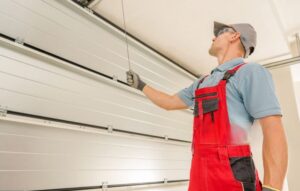
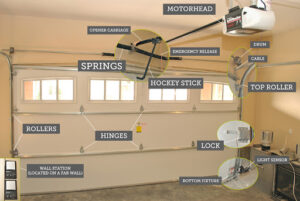
It is a red rope with a plastic handle, hanging from the trolley on the rail that runs from the motor unit toward the door, usually at about the height of a raised hand. Give it one firm pull straight down. You should hear a distinct click as the release arm drops out of the carriage. That click is the door and the opener parting company, and from then on the door is a manual door.
A note for anyone with a wall-mounted opener beside the door rather than a unit on the ceiling. Those use a different release, usually a cord or lever on the drive unit itself, and the manufacturer’s sticker beside it tells you which. The rule about the door being closed first applies just the same.
Lifting it by hand
With the springs healthy, a correctly balanced door is light. Most people are surprised the first time, because a door that weighs two hundred pounds should feel like it and does not. The springs are carrying almost all of it. Use both hands on the bottom section, lift with your legs, and take it up smoothly to where the rollers reach the horizontal track. It should stay where you leave it. If it slides back down or shoots upward, the balance is off and that is worth a service visit once the weather clears. And if it feels heavy, stop, because that is the next section.
Closing it and keeping it closed
Bring it down the same way, hands on the bottom section, in control the whole way rather than letting the last two feet drop. Then think about security, because this part gets forgotten. A disconnected door is held down by its own weight and nothing else, so somebody outside can get their fingers under the bottom and lift it exactly the way you just did. If you are going out or going to bed, throw the manual slide lock on the track if your door has one, or clamp locking pliers on the vertical track just above a roller.
Then write yourself a note on the wall button. A slide lock left engaged when the power returns and somebody presses the remote will bend the door, and that repair costs considerably more than the outage did.
When a spring is broken as well
Sometimes the door was already failing and the outage is just when you find out. This combination deserves its own section, because the usual advice becomes dangerous.
How to tell in the dark
Shine a light on the shaft above the door. A broken torsion spring shows a clean gap of two or three inches in the coil. If your door uses springs along the horizontal tracks instead, look for one hanging slack or the door sitting crooked in the opening. The other tell is a bang you heard recently, during the storm or in the last few days, which people usually assume was something falling over.
The simplest test is weight. If you have released the door and it feels like lifting the back end of a car, that is not you being out of shape. That is the counterbalance being gone.
Why the release cord is the wrong move here
With a working spring, releasing the door hands you a balanced door. With a broken spring, releasing it hands you several hundred pounds held up by nothing.
If the door is closed, that is survivable, because gravity is already doing what you want. If the door is partly open and the spring is broken, pulling the release is close to the worst available option, and the fact that it is the standard advice everywhere is exactly why this needs saying.
What to do instead
Leave the door where it is. Stop pressing the button, because an opener straining against a dead-weight door strips its gear and turns one repair into two, and unplug it if others in the house have remotes.
Getting a car out with a broken spring is a two-adult job with the door propped, done once, and it is honestly not worth doing at all if you can take a ride or move another vehicle. If nobody in the house can safely lift a door of that weight, do not try. Say so when you call, because a trapped vehicle and a household that cannot operate the door move you up the schedule. Our spring repair page covers what that work involves.
Expert note from the Deluxe Garage Doors technicians
The call we get most after a storm is not a broken door. It is a door that was released during the outage and never put back, and the homeowner assumes the opener died in the power surge. Nine times out of ten it is the trolley sitting six inches from the carriage. The other thing worth knowing is what to do while the power is actually out. Unplug the opener. When the utility restores a line there is often a surge behind it, and the logic board in an opener is the cheapest thing on that circuit to destroy. Plug it back in once the lights have been steady for a few minutes. It costs nothing and it saves a board replacement several times a season.
Getting back to normal when the power returns
This step generates most of the service calls, and almost none of them need a technician. The system is not broken. It is disconnected.
Re-engaging the trolley
Close the door fully by hand first. This matters more than anything else here. Then pull the release cord again, this time toward the motor unit rather than straight down, and hold it a moment. On most openers the release arm clicks back into the ready position, and on some the arm needs flipping so it sits horizontally rather than vertically.
Now press the wall button or the remote once. The carriage travels the rail, finds the trolley and locks onto it with a solid click. Run a full open and close afterward to confirm. The first cycle can be slower than usual while the opener re-learns its force settings, which is normal.
When it will not re-engage
Almost always because the door is not fully down. Even an inch of gap changes where the trolley sits on the rail, and the carriage cannot reach it. Push the door down firmly and try again. Second most common is a slide lock or clamp still in place, which stops the door moving at all, so check for those before assuming the worst.
Third is a release arm that has not reset. Pull the cord toward the motor again and watch the mechanism rather than yanking. If the arm is bent or the spring inside the trolley has given up, that is a genuine repair, though it is uncommon and you can usually see that something is out of shape.
Surges and the board that dies overnight
If the opener has no power at all after the outage ends, check the breaker and the GFCI outlet first. Storm-related tripping is extremely common and resetting it is free. If the outlet is live and the opener is dead, or the lights work but the motor does nothing, the logic board may have taken the surge. That is a repair rather than a mystery, and a plug-in surge protector on the opener outlet is a few dollars that prevents the next one.
Remotes and keypads that stopped working after an outage usually just need reprogramming, which takes a couple of minutes and is in the manual for your model.
If you are outside and the garage is the only way in
Every article on this subject assumes you are inside the garage looking up at the cord. Plenty of people are in the driveway in the rain, and for them none of the above helps.
The release you cannot reach
The cord hangs inside. If the garage has no side door, or the side door is bolted, or the house door from the garage is your only entrance, an outage leaves you locked out by a door whose handle you cannot reach. Keypads do not solve this, because a keypad talks to the opener and the opener has no power. Smart openers and phone apps are worse off still, since they need the opener, the router and the internet, and all three are usually down together.
Exterior release kits and the plainer alternatives
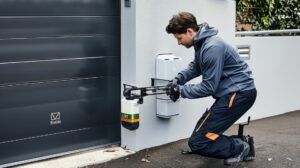
There is a proper fix. An emergency release kit fits through the top section of the door and gives you a keyed lock outside that pulls the release from indoors. Turn the key, pull the cable, the trolley disconnects and you lift the door by hand. It is an inexpensive part and a short installation, and for a detached garage or a house where the garage is the main entrance it is the difference between an inconvenience and a night at a hotel.
The plainer alternatives work too. A side door with a normal key lock, a house key with a neighbour, a spare hidden somewhere more imaginative than under the mat. Any of them beats standing outside deciding whether to break a window. Of the options, the exterior release is the only one that also gets your car out.
Setting things up so this stops happening
Everything above is what to do once you are stuck. This is how not to be stuck, and the list is short.
Battery backup and what the specification means
A battery backup keeps the opener working through an outage, running the door from a rechargeable battery in the motor head. In California it has been a legal requirement on new and replacement residential openers since a state law took effect after the wildfire seasons, when several people died unable to get out of their garages. Other states have looked at similar bills. Everywhere else it is optional, and it is the most useful option on an opener.
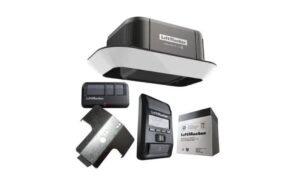
Capacity is rated in cycles rather than hours. A unit rated for around twenty cycles handles a normal outage comfortably and many rate higher. The battery runs the door slower than mains power and chirps periodically, both intentional. Many openers made in the last decade accept a factory battery unit as an add-on, so you may not need a new opener at all. Older units generally do not, which is one of the honest reasons to replace an opener that still technically works. Our garage door opener installation page covers which models take a backup.
Keeping the battery alive, which people forget
The battery is a consumable. Expect roughly one to two years, less in a hot garage, which covers most of the southern half of the country. It will tell you when it is finished, usually with a colour change on the indicator and a chirp every thirty seconds. That chirp is the moment to order a replacement, not the moment to disconnect the battery because the noise is annoying, and we find a lot of dead backups that were unplugged deliberately.
Put a reminder in your calendar to check the indicator twice a year, and if you unplug the opener for a long absence, disconnect the battery too so it is not drained and damaged while you are away.
The five-minute drill worth doing this weekend
Get everyone in the house who drives to do this once, in daylight, with the power on. Close the door. Pull the release. Lift the door by hand and put it back down. Re-engage the trolley and run a cycle. That is the whole drill, and afterward everybody knows where the cord is, what the click sounds like and how heavy the door actually is.
Do it with your teenagers and with any older relative living in the house, because if the door turns out to be too heavy for someone, that is worth knowing on a sunny afternoon rather than at midnight. Check while you are there that nothing is stacked against the door inside, since the boxes in the corner of every garage migrate into its path.
If the door felt heavy, or would not stay where you left it, that is a balance problem rather than an opener problem. Our garage door repair service covers Englewood, Venice, North Port, Port Charlotte, Punta Gorda, Rotonda West, Placida and Sarasota County, and it is a short visit before the next storm.
FAQ
- Can I run the opener from a generator or a power inverter?
- Yes, and it is reasonable during a long outage. An opener draws modest power once running, though it pulls considerably more for the second or two of startup, so size for the surge rather than the running figure. Use a properly rated extension cord straight from the generator to the opener outlet, never a cord backfeeding into a wall socket, and keep the generator well away from the house because of exhaust. An inverter already sitting in a truck will often do the job.
- My opener beeps every thirty seconds even though the power is on. What is that?
- Almost always the backup battery telling you it has reached the end of its life, and worth acting on rather than muting. Check the indicator on the motor head, since most manufacturers use a colour code distinguishing a charging battery from a failed one. Replacements are a stocked part for common models and clip in without tools on many units, and the old battery belongs at a recycling point rather than in the household bin.
- Does the outside keypad work when the power is out?
- No. The keypad only sends a signal, and the opener that receives it has no power. The same applies to remotes, phone apps and any smart-home integration, which is why none of them are a substitute for either a battery backup or a physical way in. A keypad with a low battery of its own can also fail after power returns, so if yours has stopped responding while everything else works, change its cells before assuming anything is broken.
- Is it safe to leave the door open during a long outage for ventilation?
- It is not a good idea, and after a storm it is a poor one. An open garage invites wind-driven rain, wildlife and interest from people driving through neighbourhoods without power, and a door propped part way with the opener disconnected is relying on friction to stay up. If you need airflow, use the side door with a screen or a security bar and keep the main door down. And a generator must run outside regardless of how ventilated the garage seems.